Monday, 11 June 2012

June 11th: Drawing to a Close

Today we had two visitors from Capilano University to the site, Vice President Dr. Jacalyn Snodgrass and the Dean of Arts and Sciences Dr. Robert Campbell. Bob gave them a full tour of the McKenzie Creek excavations as well as a look at our lab space on campus.

In the field today Dini, Lindsay, Ryan, Andrew, Jasmin, Alexis, Spencer M, and Willow worked on completing the excavations. We will be breaking camp this Wednesday so we are eager to finish any digging that needs to be done. Dini found a file (we think it was used to sharpen saw blades) in the "industrial" area while Willow and Spencer continued to find bone fragments and nails in the rectangular "garden" zone. In the rock feature unit, Jasmin and Alexis found more nails and pieces of wood that were either decomposed or charred. Ryan carried on with his survey project of the south wooded area behind the site.

Evan, Nathan, Mark, Meghan and I were in the lab working on individual tasks. Mark took photos of several dozen artifacts found this year for his photography assignment as Evan continued her work on completing the artifact catalog. Nathan is responsible for creating an overview of the features on the site, so today he put in some time on his report. Meghan and myself started some line drawings of a few artifacts selected by Bob that were found this year on the McKenzie Creek site. The drawings had to be to scale and as perfect as possible so that they can be published. It's often helpful to have line drawings of artifacts made of ceramic or glass as the diagnostics aren't always visible in photos.

I drew the D.D.D. bottle found in the "cabin" area of this year's excavations at McKenzie Creek. 

Meghan drew the "National Remedy Company New York" bottle. I think she did a wonderful job.

This rice bowl was also drawn by Meghan. The artifact was found in the "kitchen refuse" area of the site. The hand-painted artwork on this piece is unique as none like this have been found during digs in previous Field School years. The drawings Meghan did for this artifact are from two angles to show the artwork and the maker's mark on the bowl:


Saturday, 9 June 2012

June 8th: Week 5 Complete

Friday back in the lab, the whole crew was able to meet up and go over the last week's work. We are nearing the end of our time in the field and everyone's individual projects and assignments are starting to come together. The surveys of the surrounding areas are almost complete, which will aid Rebecca in finishing the map of the McKenzie Creek site. Dini has unpacked all of the artifacts from previous seasons and organized them in the lab according to where they were found in the Seymour Valley. We still have level bag reports to complete and the artifact catalog photos will get started next week.

Next week will be completing the field excavations, studying for our final exams, and breaking camp. I will be in the lab again on Monday doing line drawings of some of the significant artifacts that we have found this year. I will post some photos and information on Monday of our progress.

Friday, 8 June 2012

June 7th: Heavy Rain in the Seymour Valley

Only seven of us in the field today (Spencer M, Rebecca, Lindsay, Mark, Nathan, Ryan and myself) continuing excavations despite the heavy rain. The rest of the crew was either in the lab or working from home. At the McKenzie Creek site, Mark and I worked on a unit in the "industrial/cabin" area and uncovered lots of nails, a few large spikes, more melted glass, and a tin can. Some of the items (the can and a large percentage of the nails) we found on edge the east wall. I don't know that we will have time to excavate the unit to the east next to this one as our Field Time is running out (we hope to break camp by the end of next week). I think we may have enough artifacts to assume that this area is more than likely a workshop or some sort of industrial zone rather than residential.

Some more photos of artifacts from previous Field School digs...

Piece of ceramic plate with a beautiful hand painted goldfish detail.

There have been a wide variety of bottles found in the past (as well as this year) during the SVAP excavations. The bottles once contained a variety of contents including beer, sake, whiskey, sauce, medicine and perfume. As you can see in this photo, not all of the bottles are perfectly shaped which means they are hand blown and usually older than the manufactured bottles with seams.

The medicine bottles we have found range in size, colour, and style and originate mostly from North America and Asia.

Thursday, 7 June 2012

June 6th: Divide and Conquer Archaeology

A fairly small crew today in the field as Nathan, Evan and Kitty continued to excavate the "industrial/cabin" area. We suggested to Bob that this area might have been a workshop and not a cabin. The artifacts we have recovered from the units in this zone seem to support that idea.

Today there were quite a few visitors to the site including Capilano University anthropologist Maureen Bracewell and sociologist Rita Isola and her husband. Another group, including 2007 field school alumnus Lin Guenther also spent about 90 minutes on site, getting the tour and talk from Bob. We have now had five professors from Capilano and other colleges and universities visit over the past week, and three former field school members (from 2007, 2008, and 2009).

Nathan and Evan are sorting through some items (mainly melted glass) looking for anything with diagnostics on it that could be cataloged as an artifact.

Ryan and Spencer spent most of the day backfilling the excavation units at the "cabin" area. They received praise from Bob as one of the finest backfilling jobs that he has ever seen in the history of the Seymour Valley Archaeology Project.

Willow keeps digging in her unit that we think might have been a garden. She continues to find small pieces of bone, nails, and a few little ceramic fragments. We still are not sure what this area was used for a century ago, hopefully more excavation will give us clues.

Jasmin continued to excavate the rock feature next to the creek and found more nails and lots of evidence of burnt wood. We can now assume there was once some kind of wooden platform on the rockery area (perhaps a plank floor of some kind) that once may have supported a structure. We are thinking of ideas as to what it might have been if it was not a garden. Some suggestions have been a small ritual building or a meditation hut as we have seen such things in historic photos of other camps in Japan and North America. I am particularly interested in this feature and I'm hoping Jasmin can find some artifacts that will help us understand what this structure might have been used for a hundred years ago.


Dini, Alexis, Spencer K and myself were doing lab work again today (everyone else was working from home). Dini had a chance to sort through more artifacts from previous Field Schools. I took a few minutes to snap some photos of the pieces I thought were significant:

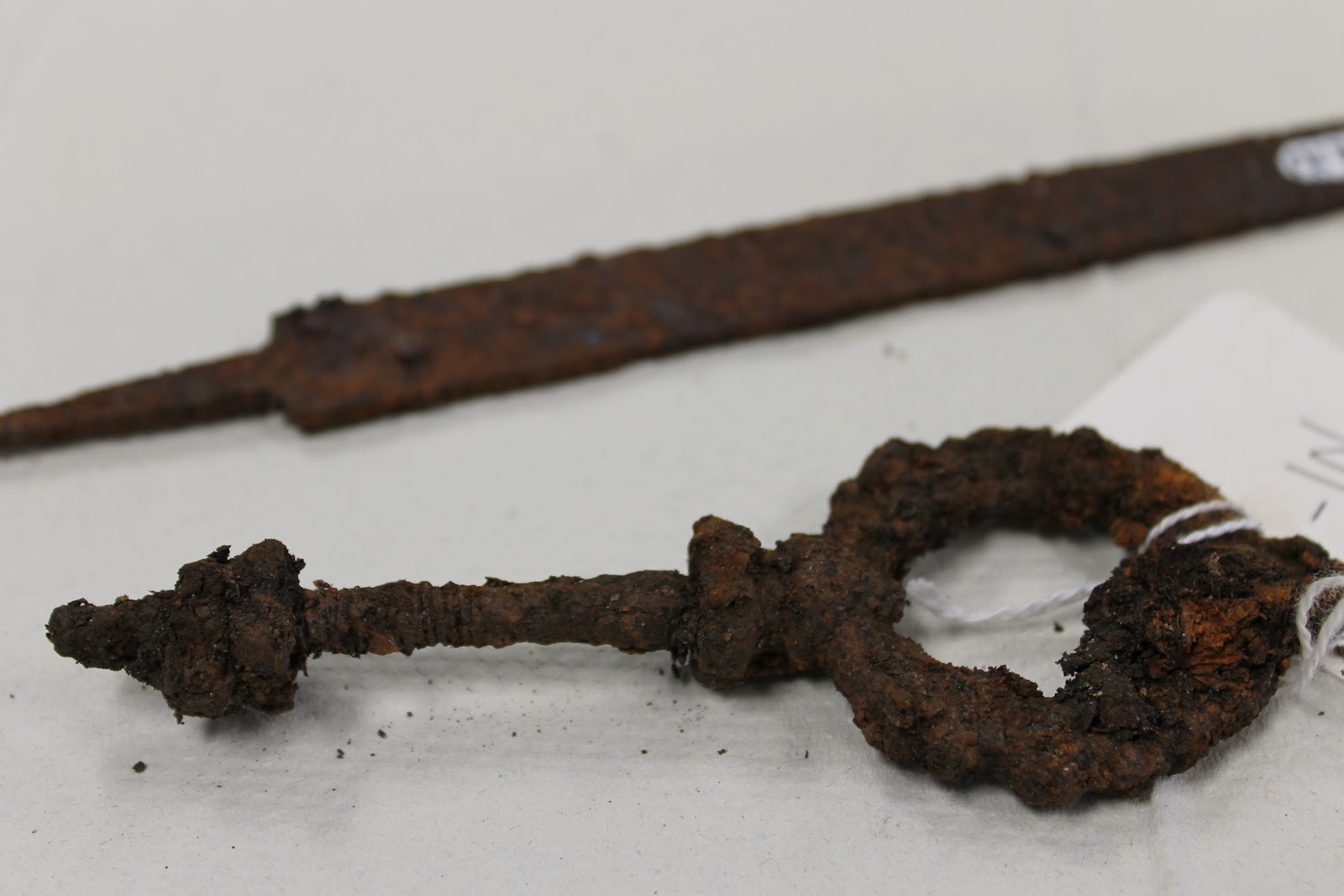
 Looks to be a pocket or utility knife. 

Pieces from a wood stove and as you can see some of the mica is still in place.  

The cap to an ink bottle 

These are either perfume or medicine bottles. We have found a few of these kinds of small glass bottles at the McKenzie Creek site.


Wednesday, 6 June 2012

June 5th: The Garden Mystery

Today a few people (Spencer M, Evan, Rebecca) were working from home, Alexis, Dini, Spencer K and myself were in the lab. Alexis is plugging away on her level bag assignment, accounting for several pounds of tin can and nail fragments (as well as pieces of glass and ceramic). Dini was organizing artifacts from past years as well as some from this season's finds to use for public education events. 

This is a video of Dini talking about her public education project:

Dini mentioned in this video that the next event that we will be featuring artifacts from the SVAP is:

SPLASH! BC Family Fishing Day & Watershed Tours Kick-Off
  • It's on Sunday, June 17th 2012 (Father's Day) from 10am - 3pm at the Lower Seymour Conservation Rerserve
  • There will be booths and information at the gazebo (near the parking lot at the end of Lillooet Road, three kilometers north of Capilano University.
There's even going to be free fishing at Rice Lake for Rainbow Trout for the day!


We had some visitors to the field site today: 
Anthropologist Tad Mcilwraith from Douglas College in New Westminster and Coquitlam, and anthropologist/archaeologist Doug Hudson from the University of the Fraser Valley. Three members of Andrew's family also came to have a look....it seems that we are developing quite the fan base.

Following up on the garden project that Willow and Jasmin are working on, we have some interesting developments. Yesterday's lab work showed that the soil samples from the areas we think may have been gardens had higher PH levels than the control samples. This is good evidence to support the hypothesis that these were once gardening zones but as the excavations began, both units turned up dozens of metal nails (which is very confusing).

Here is a photo of the rock feature that Jasmin is currently excavating (right next to the creek on the north side of the site):

Willow and Spencer getting to work on the other "garden" area:
There were lots of nails found in this unit along with some pieces of animal bone, which would make sense if it was once a garden (adding bone to a garden would raise the PH level, thus making the soil better to grow plants in). Maybe the nails were part of a structure that once held the garden in place? We hope to get more clues as we excavate further.

Here we have Lindsay and Nathan continuing excavation work on the "industrial/cabin" units. Nathan found a very large saw blade just under the surface of the moss which would support the idea that this zone was more of an industrial section of the camp rather than residential, but we're still not certain.


Tuesday, 5 June 2012

June 4th: Soil and Rust

Today most of the crew (Alexis, Lindsay, Nathan, Mark, Evan, Spencer K, and myself) were in the field excavating as Ryan and Dini continued to work on the survey south of the McKenzie Creek site. Nathan continued to dig in his unit at the "industrial/cabin" area which appears to have a depression in the sediment going as deep as 70 cm. We still are not sure what exactly this "pit" (approximately 50 cm wide at the top) might have been for or why the soil is significantly softer than the surrounding sediment. Lindsay and Nathan set up three new excavation units in that same area which will hopefully reveal more artifacts helping us piece together the puzzle of what this space was designated for in the early 1900's. Jasmin and Willow worked with Cheryl in the lab doing PH tests on soil samples taken from areas that we think may have been used as gardens. Here's a photo of the soil tests so far:


The process of rust removal by electrolysis has made a huge difference when applied to some of the metal artifacts we have found at the McKenzie Creek site. Some of the items we have recovered that are made of metal have become severely rusted and almost indistinguishable. I have mentioned this process before in previous posts, but I wanted to show some examples of Spencer K's hard work with electrolysis treatments on a few of the more significant metal finds from this year's excavations.

This is the before and after photos of a metal handle used to open and close a stove pipe flute. When found, it appeared as just chunky bits of rust in a rounded shape. The electrolysis treatment reveals astounding detail of the design on this piece (a wreath with flowers). This gives us a better idea of what to research when we're looking for diagnostics and information on stoves from the early 1900's.

 This stove piece was found in association with the flue handle. Again, originally this artifact was caked with rust and now looks almost new. We are able to make out the words "Air Tight" which is a model of wood heating stove from the early 1900's.

On a side note....

We are so lucky to be working in such a beautiful forested area in the LSCR and be so close to wildlife. Recently Mark had a chance to snap a photo of some deer just a few feet away from him while on site. They don't seem too afraid of us at all! This video clip shot by Mark shows just how close we are able to get:


Saturday, 2 June 2012

June 1st: Week 4 Is Already Over!

The 4th week has come to an end and as per usual on Fridays, we gather for a two hour recap of our work thus far. We have recovered about 80 or more artifacts (which are still being cataloged) so Bob took some time to go through some of the significant finds and describe what they represent in context to the McKenzie Creek site. Many of the artifacts are found broken, damaged, or rusted so we make as much effort as possible to piece them back together. This helps us to gather diagnostics such as maker's marks and brand names from items so that we can get a better idea of how and when they were used.

 This is lantern glass that Spencer M is helping glue back together...

We can see the letters "SMP" on this lantern. We are currently doing some research on this piece to find out approximately when it was made.

Rust removed (via Spencer K's electrolysis methods) from this tin can bottom reveals the number "204". Perhaps we can use this information to find out which brand of can this is and what it might have contained.